Wednesday, 26 August 2015

Airport Culture

When I first started flying, ('67) airports had a casual culture that was second to none, especially to  starry eyed kids who wanted to be airline pilots. You could go there and just sit in the lounge and listen to the patter of the controller or the last minute instructions by an instructor to a student who  just soloed the day before. You could absorb all that for free, and look forward to it all being applied  to you at some future point. Renting a Cessna 150 was $15 an hour with an  instructor, and $12 solo.  There was no security to speak of. You  could drive to a regional airport and walk the hangar line and see the airplanes. You could even fly into an international airport and visit the coffee shop. I did it.

In '68, I flew into Toronto International Airport with a  friend one evening, parked the Cessna on the tarmac and walked  into the airport. We had our coffee and watched the scene with some pride that we were using the same airport as the "big jets". I learned later, that some alert fuel truck driver had saved my airplane from being flipped over, by quickly driving his truck into the space between my airplane and the jet blast from a manoeuering DC-8.  I was chastened, and grateful, and despite the close call, eager to experience the many new and exciting things about career flying.

Today things have changed. After 9/11, a false flag event, attributable as yet, to no one, but hugely benefiting  - the planners of the "Project for a New American Century"  the airport culture changed. In fact the world changed.  Flying from an  airport is no longer fun. The "War on Terror" assumes  everyone who enters even a regional airport is a potential terrorist. The resulting security is a form of  psychological oppression, because all employees in that culture, be they police, baggage check-in, immigration, or janitorial staff  have been trained to justify their salaries as the last line of defense against a population who ironically have never, ever, even met a terrorist or experienced  a "truthful" terrorist event.  In fact  despite what the establishment media tells us, there have not been any true terrorist events. The records testify, that they have all been deliberately contrived and then published to condition the public so that, among other things, we distrust each other, and begin to hate airports.

I don't want play that game anymore.
Yesterday, after a long absence, I visited a regional airport and the security equipment, surveillance, fencing, and overbearing police presence reaffirmed my aversion to airports and my ambition to fly  without their control, licensing or services.  It's impossible to tally accurately, but all of the above  make flying very expensive. You pay one way of another for all  those police and all the time you are a criminal suspect .
But in Costa Rica, except for control zones, (3)  95 % of the airspace is  uncontrolled  airspace. This  Blog is re-dedicated to promoting its use specifically with ultralights that can be the personal  responsibility of an individual.

In the picture,  engineer and machinist  Ron Flitton opens a crate of engine parts, which this summer, has become a 65 HP, 4 cycle , air cooled, turbo charged , computer controlled, fuel injected  helicopter engine that runs on regular fuel. Fuel and the ability to land anywhere and refuel, is the key to accessing all free airspace.


Wednesday, 25 February 2015

Test Flight 7 February 2015

Engine runs at the hangar  have  yielded  data that  has allowed Ron to reduce the radiator size for  cooling both oil and water . In addition the electrical relays relative to the engine control unit have been reinvented and made redundant in order to ensure that engine will run and run. All this work was tested successfully on this 30 minute flight on a farm in Herradura, Costa Rica .


Saturday, 15 March 2014

Flight Test 12 March 2014

Wednesday afternoon 12th of March 2014 was  the occasion  of the first  test flight of the Mosquito "L" Model at Herradura Costa Rica. You will recall that the move to a warehouse/shop  facility was  completed in  June 2013  so that engineer Ron Flitton could could be employed in a shipwright service at Costa Rica's premiere resort center Los Suenos  as well as  spend time on the  completion of theVerti Drive 750 Engine.  After two years of full time work, we had to do it this way.

When the move was made there were several power problems with the motor which were better solved on the test stand rather than on the airframe. Ron's report on the  success of the trouble shooting was posted last fall in this Blog, but the acid test of any test stand success is the application of power to hover.
Wednesday was our day.  In the post flight inspection, the usual "small stuff" showed up, as every  aircraft coming out of refit has items that should be tighter or secured differently. Our experience was no exception.
The plan therefore, over the next 8 months, is to continue to modify and  change  areas of the engine were weight can be eliminated. The overall dimensions  will  also  shrink so that the engine  will  be a suitable product for  ultralight helicopters in general.
The Mosquito "L" model   we have in   Costa Rica will  be the test  flight airframe but  when  we are satisfied that the engine has  reached  the goal, it will be  ready for  installation on the Mosquito XE.
 

Thursday, 28 November 2013

November 2013 Update - Engine Installation

23 November 2013

Today, Ron Flitton reports that  he has moved the  engine by himself successfully, from the Test Stand to the helicopter and has begun to reinstall the electrical wiring.


Tuesday, 19 November 2013

Ground Handling

It's a given that every flying machine has to alight sooner or later including the birds, so planning how to secure a helicopter on the ground is a pretty important question to answer early on.

When we first moved to Costa Rica, I  remember dreaming how "neat" it would be to own a light airplane to travel the country. However, when it came time for our first overnight at an isolated airstrip, the awful truth dawned : Other than sleeping under the wing, how could we secure the aircraft against vandalism and theft while we were away visiting the sights ?
But.....as one would have it, a would-be guard came out of nowhere, and after dramatically describing the dangers of leaving the aircraft unattended, he suggested a fee that would ensure that none of the above would happen. At that point, I had two  choices: (1) be a victim of "blackmail"or (2) be a slave to the security of the aircraft.
Idea Light Comes On:  If we wanted to achieve personal air travel in Latin America, there would have to be some thoughtful planning in a light helicopter, that would ensure you could safely land adjacent to secure parking areas.

Now to land, a pilot needs a debris-free 30 foot  circle, and good approaches free of wires. Few actual parking areas have all these prerequisites so it's obvious that in most cases, the pilot will need to move the machine after landing. Wheels are therefore essential.

I should say first that individual landing pads are standard on each gear leg in order to land the machine safely in one place. Wheels by themselves would require brakes, and a tire offers a  much smaller foot print that won't necessarily support the loaded weight of the machine in every landing situation.
So following early prototypes, a light spoke carriage wheel was chosen, that in the air would ride above the landing pad, and on the ground, would be levered through 190 degrees, lifting the landing pad clear.of the ground.  A tow-bar at the front would permit the pilot to lift the forward pad clear, so that the helicopter could be rolled in any direction.
A very important consideration for this operation is speed and reliability for these factors make it possible to choose landing  areas which may normally be thoroughfares for people or vehicles. The shorter the time interval between landing  and  moving, the more parking options  you will have. In tests, the time between disengaging the rotor and moving the  helicopter clear of any other traffic can be under a minute.
 
So, the combination then of landing pads, "quick" wheels and a rotor brake makes landing almost anywhere a possibility,

In this Mosquito"L" feature then --another step toward the goal of "Free Airspace".


Monday, 21 October 2013

"Free Airspace"

To the 21st century person, it seems a refreshingly strange prospect to contemplate the free enjoyment of flying yourself without first acquiring a license and then permission for each flight. In recent years, as new materials and expertise have brought many different kit airplanes and helicopters within the range of more and more people, the licensing agencies, who normally delight in an expansion of their authority, have found it necessary to reject the workload that would be required to control every single aeronautical contrivance, and to content themselves with creating personal licensing for aircraft weight categories*. In fact, if you talk with these bureaucrats, you may even find one who is sufficiently reckless to admit that unlicensed flying is a "de facto" reality. Bravo for just a little common sense.! In essence the machines are pushing the argument, for very easy kits are available, and with just a little more imagination "Free Airspace" could be a real possibility for many. * (Logical-- Aircraft weight is directly proportional to public liability) . So.... what does "Free Airspace" mean ? Three things : (1) Freedom from licensing and control; (2) Freedom from airport and airspace environments; (3) Freedom to privately exercise your travel imagination and capabilities. In the weeks ahead, I am going to explore these three in depth and we are also going to create a mandatory feature list for a personal helicopter that will allow you to exercise all three freedoms. Coming soon, the Mosquito "L" Model, will meet these requirements but before that happens, we want you to have a clear vision for its use.

Personal Locator Beacon

When I  first learned to fly  in '67,  the situation I  feared most was "getting lost".  I have been temporarily unsure of my position many times in my 13,000 hour career, but only lost -- once. Rather than stay lost over southern Ontario, on that snowy day in'68,  I landed my C-150 on a farm driveway,  and turned around in front of the kitchen door as the family was having lunch. Pictures taken of all the children on the airplane, and information exchanged,  I flew on to my destination. The farmer told me later that from then on, the children always looked left when leaving the kitchen, hoping to see an airplane landing.
Two problems needed solving here: (1) I  was on a  Flight Plan and the Toronto controllers responsible for me, could not  identify me to help me get back on course......and (2) if  I did not arrive, no one would know where to look.
Happily, there  was somewhere to land and  someone to ask.

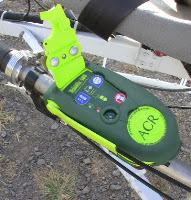
The Mosquito "L" Model has a dual package Global Positioning System (GPS) and Personal Locator  Beacon (PLB) -- one on each flight control. The PLB makes flight following by Air Traffic services unnecessary. The GPS position is constantly relayed to the PLB so that in the event of a crash or even a landing somewhere out of fuel, two seconds after the  "Activate"  button is pushed  by the thumb of the left hand, the exact position of the aircraft is relayed by satellite to CFB Trenton Rescue Coordinaton  Center, or any other Rescue Coordination Center that you register with. They  have a list of family to call, to whom, ( it is assumed) you would have communicated your flight plans. That is your part : Inform your family members or a  trusted friend just what you are planning. Fully informed then, the search would  go directly to your  Lat /Long position on their satellite plot.

So rather than fly at the altitude necessary to give a position report to Air Traffic Services, you never have to talk to them. You can fly at any altitude that is safe for an autorotation knowing that the PLB will bring help  to your position  povided  you "Activate" when any trouble arises. Even if  you are scared, lost and  running low on fuel, if you "Activate" you bave asked that help "Standby".  No one will go home or launch a search until you have either communicated you are safe,  or your satellite  position stops moving .


Rotor Brake

Rotors turning on the ground is a vulnerable period in the flight sequence. Accidents can occur because a helicopter that has just landed, can no longer avoid an unforeseen danger while it is in the process of stopping the rotor. Therefore the pilot must choose a landing area which is far enough away from possible human interference so that he can shut down safely. This of course is the rationale for airports and licensed helipads - guaranteed safety. But this rationale frustrates the freedom to really use the helicopter for what it is designed for - to land almost anywhere. 

The Mosquito "L" Model  is equipped with a rotor brake which allows the pilot to stop the rotor routinely in under 30 seconds and faster should there be an emergency. If you think about it, this increases dramatically the areas where one might land. As we progress, along this route toward "free airspace" thinking, this feature becomes very important, especially if you want your machine to take you where you want to go . 


Verti-Drive 750 TC

The search for the ideal engine for a single place ultralight  helicopter has always been limited by one thing or another. 2 Cycle engines are light weight with immediate power, but the engine requires mixed fuel and oil, and careful handling in order to be reliable ....... and when it quits, no one is surprised ----for it is two cycle.
Those parameters are not quite good enough if you are going to be flying over open water, or mountains, or jungle, or built-up areas, or just a long way from home over barren territory. The engine has to produce reliable power, hour after hour, no matter what you encounter. 
For your peace of mind, it can never fail.
It has to run so reliably, without a burp or fluctuation,so that you are entirely free to concentrate on navigation or the task at hand.

In commercial aviation, it is just this sort of confidence that enables the pilot to fly the helicopter to the edge of the flight envelope, because, if he has  fuel in the tank and he has not accepted a task that is beyond his skill level, he'll pull it off and return home to tell about it.


Ultralight helicopter aviation doesn't generally have those sort of stories.
Now, if that is to change, and the personal use pilot is to have the same confidence of the commercial pilot, the ultralight market has to have a power plant that has the same reliable qualities. Otherwise the ultralight  helicopter will always, with few exceptions, be a toy thatoperates over accessible territory and within rescue range of people on the ground.

The Verti-Drive 750 TC is a new engine conversion whose developers definitely aspire to all the peace of mind that lesser power plants do not provide -- and more.

In fact, 4 cycle power makes the principle of  "free airspace" possible for the first time: Freedom to fly to any horizon and beyond.
The combination of 4 cycle power on a light airframe, with easily deployed landing  gear, a rotor brake, and a simple fuel bladder, makes it possible to go anywhere you wish because there will always be Super Grade fuel ahead of you at a convenient roadside gas station.
2 Cycle might aspire to such freedom, but you would have to burden yourself with carrying the synthetic oil you need to mix with the fuel, and then, -- when that was all gone - how would you get back ?

The key to Free Airspace then, is an engine that runs so reliably on miserly amounts of regular gas, that you can strap yourself in for a four hour flight, and know you are going to get there -- just as  reliably as if you were driving your car, and a lot sooner. 
Let's see what the future holds.

Freedom from Licensing

The truth is, that all of us have been programmed from birth to expect licensing or permission for many activities that are innocent enough to be considered personal responsibility. Therefore to discover that circumstances have contrived to put a freedom back in our hands is a welcome turn of events which should be exercised - for three reasons (1)  To assure ourselves and others that we don't need licensing to be responsible and (2)  to establish a precedent in the event the  licensing  agencies  decide to reconsider and (3)  to overcome the habit of blindly accepting the establishment of socialist policies which subtract freedoms.

To regress a little, I am not saying that licensing in the public realm is unnecessary-- On the road, it compels individuals to train and achieve standards, where they are to operate vehicles that carry others and collision and death are possible. The same rationale is there to protect air travelers. Where one set of flight controls and two human beings are the means of safeguarding the lives of many innocent passengers, demonstrating competence to operate the aircraft in advance is a necessary step. It makes insurance companies breathe easier as well, for it is they, who would have to payout the claims for multiple deaths and equipment loss, should one incompetent or troubled person make a tragic decision that resulted in a death or injury claim.

But now Ultralight Aviation comes onto the scene. Aircraft designed to carry one person in airspace where there is little or no commercial  traffic, and where a commitment to protect people on the ground is a common sense consideration undertaken by the pilot, licensing has no purpose. The only one at risk is the pilot and his machine.

Freedom from Airports & Air Traffic Services

Plans for "home-built" fixed wing airplanes began to blossom in Popular Mechanics articles of the 1950's.  Officially, you had to have a license to fly a home-built, which meant you generally had to operate from a runway with a mix of commercial and private traffic.  There was therefore no unlicensed access to "free airspace" when your coming and  going was predominantly controlled  from public airports. The result was that pilots trained  for  a license and they flew registered airplanes.

At the same time, the late 50's,  an unseen yet powerful hand, arbitrarily established an important baseline for all commercial  aviation:  Airports would become the predominant access points for public air travel. The decision laid aside well advanced  plans for powered autogyro technology that if pursued would have reduced the need for airports, access freeways, long holiday lines and travel delays. The Fairey Rotodyne and its successors would have moved all regional air traffic to  municipal heliports and shuttled  travelers to central international  airports  for long range jet travel. The result would have been a saving of millions in land use, a reduction in danger and noise pollution,  and an increase in the convenience and affordability of air travel. History however, records the idea cancelled, and since then, we have learned to endure an Orwellian "airport fear culture" in the  post 9/11 world.

Perhaps the negative decision was just happenstance, but the possibility does exist that some far-sighted world leaders saw airports as a means of funneling the traveling public through centralized  facilities which could  become a significant means of conditioning and control.

The advent of ultralight rotary winged vehicles that remain totally clear of government airports  contradicts the ominous trend that airports have come to represent.
There are reasons enough then to enjoy "free airspace'.

Simulating Helicopter Flight

 My first exposure to Simulators was 1969 in Moosejaw, Saskatchewan, where, as a new pilot trainee, I had just been introduced to the Canadair CT 114 "Tutor".  It was the Trudeau years and so the military wanted to save money any way they  could.  One of those ways was  to  schedule a percentage of our instructional time to emergency and  navigation  sessions in the Simulator.  Except for the checklist procedures, all the exercises were via the instruments. There was no reason to simulate what was happening outside.
Then in 2004, along comes Microsoft with real simulation for a helicopter but it's operated by computer keys. Ahh .... yes, Saitek produced pedals and a "computer games" cyclic, but the visual environment was a flat screen --- hardly realistic when training to do the real thing.

In the military world, the advent of  helicopter simulation really took the science to new heights, portraying a ground environment that responded as it would to the proper use of the helicopter controls or vice versa. The control pressures might be a little different from one machine to the next,  but the eye hand coordination necessary to  fly, was the same .

For the Mosquito then, we wondered just how we were going to affordably access this military style simulation technology and get the novice into the air well prepared ? Could we get the Microsoft 2004 program to function  inside a 180 degree four screen environment that showed the pilot the ground ? If yes, we could give the pilot all the eye hand coordination that he could handle at a relatively small expense, and....as a bonus, the absence of noise and danger would be welcome.  

Chris Stroesser, a Canadian computer technician, took on the project in 2006, and when it was  successfully completed in 2007,  Microsoft distanced themselves, withdrawing all warranty support.  Chris must have been working in uncharted territory .

No  matter -- today,  it's working flawlessly and it is  available for use when pilots want to simulate flying a helicopter in the most economical manner.